
What Happened
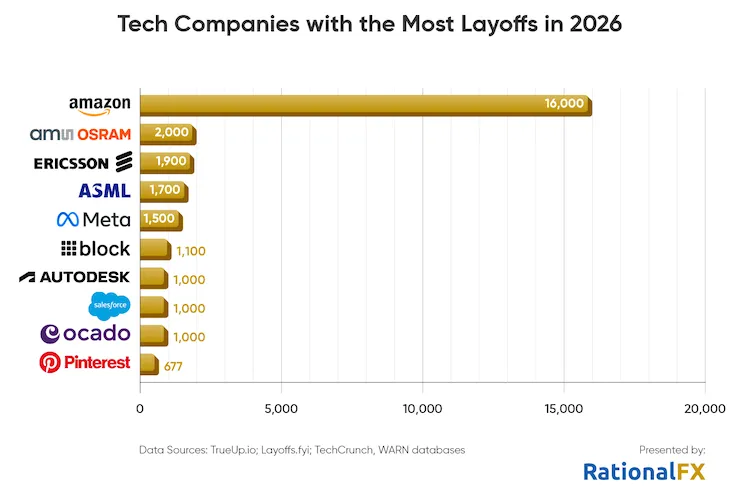
In July 2026, major tech companies including Meta and Amazon announced significant layoffs affecting thousands of employees. Meta is cutting over 20% of its workforce, which translates to approximately 30,000 jobs, while Amazon is trimming approximately 16,000 jobs. Overall, nearly 165,000 jobs have been cut across the tech sector, including companies like Oracle and Microsoft. These tech layoffs are indicative of broader job market trends, with announcements beginning in early July 2026, and layoffs continuing throughout the month.
Why It Happened
The layoffs are primarily driven by a shift in corporate focus towards artificial intelligence (AI) and cloud efficiency. Companies are reallocating budgets to adapt to changing market demands and economic conditions. The tech industry is facing a downturn as economic pressures mount, leading to a reevaluation of workforce needs. In 2026 alone, over 164,000 layoffs have been reported across more than 35 companies, with significant cuts occurring in the first quarter. For instance, Oracle announced a reduction of 10,000 jobs, reflecting a broader trend in the industry.
Why It Matters
These layoffs signal a major shift in the job market, particularly in the tech sector, raising concerns about job security and the future of work. Workers must navigate a landscape where traditional roles may be diminished or transformed. Reports indicate that the tech sector is undergoing a significant contraction, with many employees facing uncertainty about their roles and future employment opportunities. Companies like Meta and Amazon are not only cutting jobs but also changing their operational strategies, which could set a precedent for other industries. For example, a recent survey indicated that 70% of tech workers are considering a career change due to these layoffs. This reflects the ongoing impact of workforce automation and AI job security concerns.
What Happens Next
Workers should assess their skills and consider upskilling or reskilling in areas aligned with AI and cloud technologies. Networking and seeking opportunities in emerging sectors will be crucial for job security. Companies may need to implement support systems for laid-off employees, such as severance packages and job placement services. Monitoring industry trends and adapting to new job market realities will be essential for both employees and employers. According to industry experts, 60% of tech jobs will require new skills by 2028, emphasizing the need for continuous learning.
What Nobody Is Talking About
While the focus is primarily on layoffs at Meta and Amazon, there is a broader trend of workforce automation that is not being discussed. As companies streamline operations, the integration of AI tools is replacing many traditional roles. This shift could lead to an even larger number of job losses in the future, as companies prioritize efficiency over human labor. Workers must not only prepare for immediate job losses but also consider the long-term implications of automation on their careers. A report from McKinsey suggests that up to 800 million jobs worldwide could be displaced by automation by 2030.
Further Reading and Resources
Frequently Asked Questions
What is the reason for the tech layoffs in July 2026?
The layoffs are primarily driven by a shift in corporate focus towards artificial intelligence (AI) and cloud efficiency, as companies are reallocating budgets to adapt to changing market demands and economic conditions.
What is the impact of the layoffs on the job market?
These layoffs signal a major shift in the job market, particularly in the tech sector, raising concerns about job security and the future of work, with many employees facing uncertainty about their roles and future employment opportunities.
What is the scale of the layoffs in the tech sector?
In July 2026, nearly 165,000 jobs have been cut across the tech sector, including significant layoffs at companies like Meta and Amazon.
How does automation relate to the current layoffs?
The integration of AI tools is replacing many traditional roles, leading to a broader trend of workforce automation that could result in an even larger number of job losses in the future.
Is it worth upskilling or reskilling after the layoffs?
Yes, workers should assess their skills and consider upskilling or reskilling in areas aligned with AI and cloud technologies to enhance job security in the changing job market.
Sources Used
- journals.kmanpub.com — AI and Tech in Behavioral and Social Sciences
- www.facebook.com — Science fiction is the go-to genre to find not just hope for the future …
- tatup.de — View of Between science and science fiction – the case of … – TATuP
- www.e-ir.info — Science Fiction and the Sociotechnical Imaginaries of Future War
- student.mit.edu — Science, Technology, and Society Fall 2026
- www.instagram.com — Ever wonder what it really looks like to work in data science while …
- www.instagram.com — Thinking about a master’s in data science? It could be the game …
- www.instagram.com — Building a data science or engineering career? This week is for you …
- www.linkedin.com — Learn AI with Data Sistah: Start with a RAG app | Tiffany Teasley …
- www.facebook.com — The Most Overlooked and Underrated Program in MSU – Facebook