

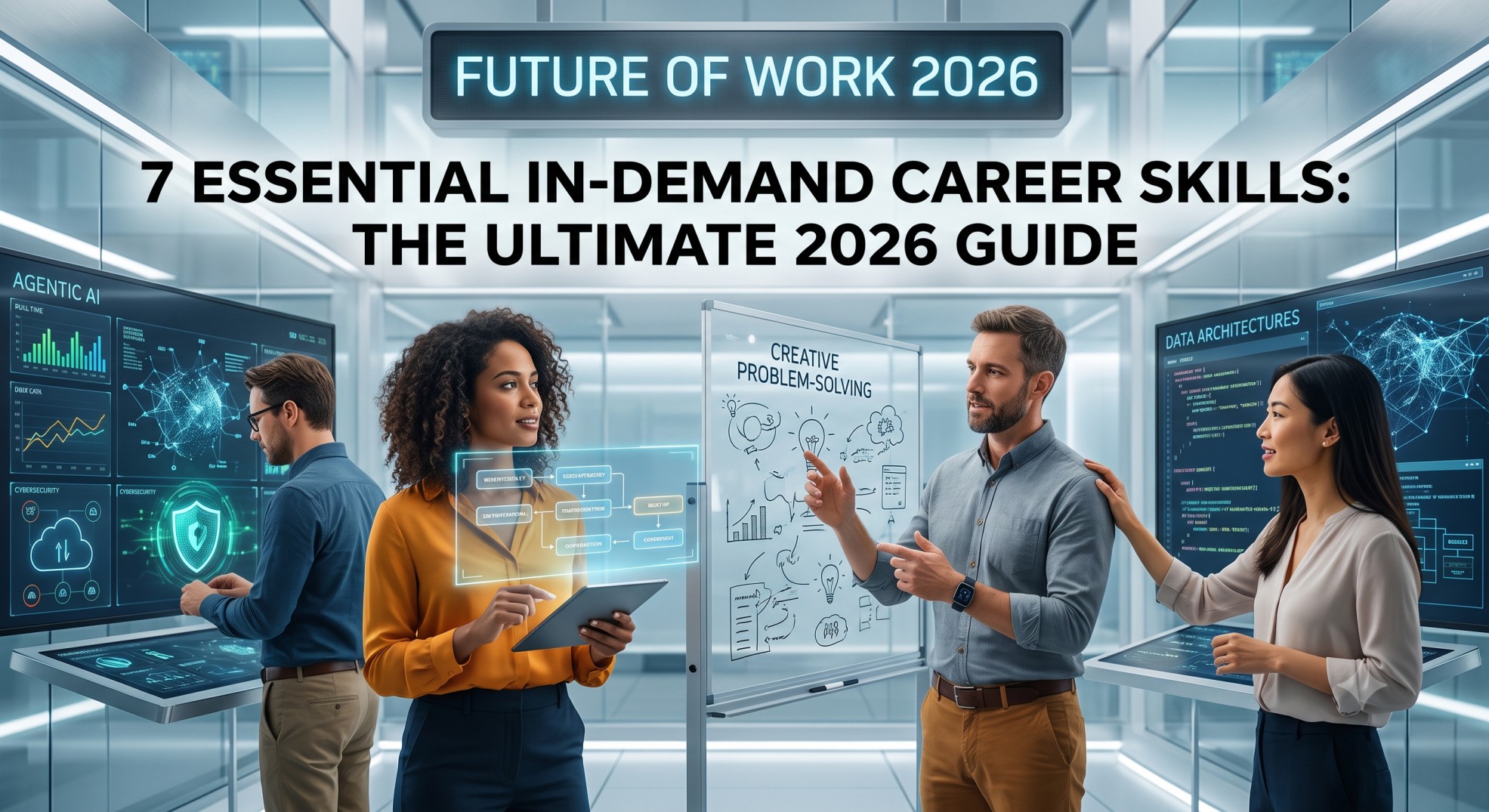
Understanding which In-Demand Career Skills are most valued by employers can make the difference between professional stagnation and a major career leap. A joint report from NASSCOM and Deloitte estimates that 37% of entry-level IT jobs are currently being impacted by AI, shifting the human role from mere execution to critical oversight, exception management, and quality assurance2.
To stay competitive, professionals must continuously update their toolkits. In this comprehensive report, the analysis will unpack the most critical In-Demand Career Skills, examine the market dynamics driving these changes, and provide an actionable strategy to future-proof any career trajectory.
The Evolution of the Global Talent Market
The defining characteristic of the 2026 labor market is the acceleration of artificial intelligence from a novel experimentation phase into everyday business execution3. This transition has fundamentally redefined what constitutes valuable labor across all sectors.
According to the World Economic Forum’s 2026 report on entry-level work, AI is reshaping rather than entirely eliminating early careers4. Technological literacy, particularly regarding large datasets and language models, is projected to grow faster than any other competency over the next five years5.
However, technology creates the demand, while human judgment determines who retains their position. The most lucrative In-Demand Career Skills now require a synthesis of digital fluency and complex cognitive reasoning. A programmer who merely writes basic code or a customer service agent reading from a script is highly vulnerable to automation2.
The macro-economic hiring trends vividly illustrate this shift. In India, the Global Capability Center (GCC) ecosystem has grown 3.4-fold since 2021, and nearly 64% of all newly created GCC roles now explicitly require AI, data science, or intelligent automation expertise7. Interestingly, this expansion is accelerating fastest in Tier-2 cities like Coimbatore, Jaipur, and Kochi, which are experiencing a 23% year-over-year recruitment growth7.
Organizations are building these centers not simply to reduce costs, but to develop the AI, engineering, and product capabilities that run their global businesses7.
Core Technical In-Demand Career Skills
The technical landscape is dominated by the need to manage, secure, and leverage vast amounts of digital information. The highest-paying technical In-Demand Career Skills revolve around intelligent architecture, scalable automation, and precise data interpretation.
1. Agentic AI and Applied Prompting
If generative AI dominated previous years, Agentic AI is the defining technological force of 2026. Agentic systems go beyond simple prompt-and-response interactions; they execute multi-step workflows, monitor digital signals, utilize integrated tools, and improve through continuous feedback loops8.
Professionals capable of designing, scaling, and evaluating these autonomous agents command massive market premiums. Key competencies within this domain include advanced prompt engineering, multimodal prompt design, and rigorous AI output validation5. The integration of large language models (LLMs) into daily business operations requires specialists who can ensure performance, ROI, and strict security compliance8.
The talent gap in this specific area is severe. A joint NASSCOM-Deloitte projection indicates that the AI talent demand in India alone will exceed 1.25 million by 2027, with the supply constrained by outdated university curricula2. Consequently, mastering these specific In-Demand Career Skills offers unparalleled job security and compensation growth.
2. Data Literacy and Business Analytics
As global enterprises digitize, the volume of accessible data is expanding exponentially. By 2025, global data generation reached staggering levels, yet raw data remains effectively useless without sophisticated human interpretation11.
Data literacy involves uncovering hidden patterns, transforming raw metrics into actionable intelligence, and communicating these findings clearly to stakeholders3. Organizations utilizing advanced customer data analytics platforms report significantly higher annual growth rates, making analytics a central pillar of strategic planning3.
Proficiency in platforms such as SQL, Python, Tableau, and Power BI forms the technical foundation of these In-Demand Career Skills12. The objective is to foster a corporate culture of evidence-based decision-making rather than relying on intuition.
3. Cybersecurity and Cloud Architecture
The migration toward distributed, cloud-based architectures has elevated cybersecurity from a back-office IT concern to a primary board-level priority. Digital threats are multiplying, and organizational exposure to cyber risk is at an unprecedented high3.
Cybersecurity awareness and ethical hacking are critical In-Demand Career Skills. Modern defense strategies heavily utilize AI-driven security automation, which can identify incidents approximately 80 days faster and save organizations millions per breach compared to legacy systems3.
Simultaneously, cloud computing expertise remains indispensable. Businesses rely entirely on cloud infrastructure for scalability, global collaboration, and digital resilience3.
The table below outlines the current salary landscape and required certifications for these critical technical roles, highlighting the financial return on mastering these In-Demand Career Skills.
| Technical Role / Specialization | Entry-Level Salary (LPA) | Senior-Level Salary (LPA) | Recommended Industry Certifications |
|---|---|---|---|
| Cloud Architecture | ₹5-10 LPA | ₹25-40 LPA | AWS Certified Solutions Architect, Google Associate Cloud Engineer14 |
| Cybersecurity / Ethical Hacking | ₹4-9 LPA | ₹40-80 LPA (CISO) | CISSP, CompTIA Security+, Certified Ethical Hacker (CEH)14 |
| Data Science & Analytics | ₹6-12 LPA | ₹20-35 LPA | IBM Data Science Professional, Microsoft Azure Data Scientist14 |
| AI / Machine Learning Engineering | ₹8-15 LPA | ₹30-50+ LPA | Google Cloud Professional ML Engineer, IBM AI Engineering14 |
Human-Centric In-Demand Career Skills
While technical proficiency secures initial employment interviews, cognitive and interpersonal capabilities drive long-term career progression. As routine tasks are automated by agents, the uniquely human elements of work become the primary differentiators in the labor market.
4. Transformational Leadership
A pervasive theme across global employment surveys is that AI literacy may facilitate hiring, but leadership capabilities secure promotions15. A recent global survey by the Graduate Management Admission Council (GMAC), surveying over 600 corporate recruiters across 39 countries, found that communication, problem-solving, and adaptability remain the most sought-after skills15.
Transformational leadership involves inspiring teams, navigating complex organizational changes, and aligning day-to-day operations with long-term business objectives13. As organizations deploy autonomous agents to handle repetitive workflows, human managers must focus on high-level strategy, talent development, and cross-functional coordination.
The ability to guide a distributed, technology-enabled workforce requires nuance, vision, and robust conflict-resolution capabilities6. These In-Demand Career Skills are highly insulated against automation and remain essential across every industry sector.
5. Emotional Intelligence (EQ) and Empathy
Emotional intelligence encompasses the ability to recognize, understand, and regulate personal emotions while deeply empathizing with the perspectives of others11. In high-pressure corporate environments, EQ is essential for building resilient relationships and maintaining positive team dynamics.
Empathetic professionals communicate more effectively and resolve disputes with greater efficiency11. Furthermore, as businesses expand globally, cross-cultural intelligence—a critical subset of EQ—is increasingly vital for seamless integration and collaboration across diverse demographic boundaries12.
Developing these In-Demand Career Skills ensures professionals can foster trust, which remains the un-automatable foundation of successful commercial partnerships and client relations.
6. Creative Problem-Solving and Adaptability
The modern business environment is characterized by persistent volatility and rapid technological shifts. Consequently, resilience, flexibility, and continuous learning dominate the list of essential human traits identified by the World Economic Forum5.
Creative problem-solving involves approaching operational challenges from unconventional angles and synthesizing complex information to generate innovative solutions11. Workers must possess the adaptability to pivot swiftly when market conditions alter or new agentic tools are introduced.
This agility prevents cognitive stagnation and allows professionals to continuously integrate new methodologies into their daily workflows, constantly reinforcing their overall value to the enterprise14.
The Real-World Impact: An Enterprise Case Study
To understand the tangible commercial impact of these In-Demand Career Skills, one must look at how businesses are successfully restructuring their operations. The integration of advanced AI and human oversight has yielded unprecedented efficiency gains.
Consider the operational transformation at TechFlow Industries, a logistics and supply chain firm. Facing a crisis characterized by a 47% jump in customer complaints and severe delivery delays, the company was struggling to scale without drastically inflating headcount18. The leadership team, guided by personnel with strong analytical and AI literacy skills, pivoted toward a comprehensive Agentic AI implementation.
Rather than utilizing basic chatbots, they deployed smart systems that monitored supply chain data, made independent coordination decisions based on set guidelines, and continuously learned from the results18. The execution of this strategy relied heavily on human workers transitioning from routine data entry to exception management and strategic oversight2.
Within eighteen months, the strategic investment in AI agents generated over two million dollars in operational savings and revenue growth18. Furthermore, the agents successfully cut processing errors by 68% and increased output by 42%18.
This case study perfectly illustrates why combining technical AI integration with strategic human leadership represents the pinnacle of modern In-Demand Career Skills. The technology handled the cognitive load of coordination, while the human staff focused on creative problem-solving and client relationships.
How to Build In-Demand Career Skills
Acquiring these vital competencies requires a proactive, structured approach to continuous professional development. The modern educational ecosystem offers highly flexible pathways that bypass the limitations of traditional, multi-year degree programs4.
First, professionals must leverage targeted online certifications provided by authoritative technology vendors. Credentials such as the Google Cloud Professional Machine Learning Engineer, AWS Certified Solutions Architect, and specialized cybersecurity certifications carry immense weight during the precision hiring process1. These structured programs provide the foundational technical knowledge necessary to operate complex digital systems.
Second, theoretical knowledge must be paired with work-integrated learning. Employers actively seek portfolios demonstrating applied problem-solving over generic academic achievements4. Professionals should focus on integrating AI tools into their existing daily workflows.
Practicing advanced prompt engineering, automating routine administrative tasks with tools like Microsoft Copilot, and rigorously validating machine-generated outputs builds practical fluency that cannot be replicated through passive study5.
Third, developing human-centric In-Demand Career Skills requires active workplace engagement and mentorship. Connecting with seasoned industry leaders provides critical feedback regarding emotional intelligence, conflict resolution, and strategic thinking6. Professionals should actively seek opportunities to lead cross-functional projects, present data-driven narratives to executive stakeholders, and manage remote collaborations13.
To stay updated on the latest shifts in the labor market and continuously refine these competencies, professionals should explore external resources like The World Economic Forum for global labor trends, and read this trending article for highly targeted, industry-specific career strategies.
Conclusion: Mastering the Future of Work
The 2026 professional landscape heavily rewards adaptability, continuous learning, and the precise application of advanced technology. Static career paths are entirely obsolete; they have been permanently replaced by the necessity for continuous, dynamic upskilling13.
By accurately identifying and systematically developing the most critical In-Demand Career Skills, professionals can navigate economic volatility and technological disruption with absolute confidence. The most successful individuals in this new economy will not be those who solely master complex backend code, nor those who rely exclusively on interpersonal charm.
Instead, the highest market premiums belong to hybrid professionals. These are the individuals who can seamlessly integrate autonomous AI workflows, interpret complex data streams, secure digital infrastructure, and lead diverse human teams with empathy, agility, and vision.
By taking deliberate, strategic ownership of their professional development and focusing on these paramount In-Demand Career Skills, the modern worker can unequivocally secure their place at the forefront of the global economy.
Works Cited
- Companies prioritising AI readiness, specialised skills over large-scale workforce expansion: Report, The Economic Times
- India’s AI Talent Gap Is Real, Growing, and a Business Crisis in the Making, Times of India
- Top Skills in Demand 2026: How to Build a Future-Ready Workforce | CSG Talent, CSG Talent
- Doctor, engineer… or something else? How India’s career dream is changing, Times of India
- Skills to Have on Your Resume in 2026 (WEF, LinkedIn & Coursera Data) – HAIRED, HAIRED
- High-Demand Careers in 2026 and How To Qualify – Upwork, Upwork
- AI skills power nearly two-thirds of new GCC hiring in India, The Economic Times
- 26 Most In-Demand Tech Skills For 2026 – QA, QA
- TensorBlue: AI Development Company for Apps & Software, TensorBlue
- Top Skills to Learn in 2026 for High Salary Growth – Global Skill Development Council, GSDC
- Future-Proof Your Career: The Top 10 Skills Employers are Looking for in 2026 – St. John’s University, St. John’s University
- Top Skills Employers Want in 2026 & How to Learn Them Online, AIU
- What Skills Are Employers Looking For in 2026? Essential Insights – CapRelo, CapRelo
- Top 10 Emerging Skills in India for 2026: Your Complete Career Guide, CII Skills
- Why Gen Z’s next promotion may depend less on AI and more on leadership skills, India Today
- 12 Most In-Demand Skills for 2026 (and How to Learn Them) – CityU of Seattle, CityU
- Top In-Demand Skills Students Must Learn in 2026 | Complete Guide, MSU
- The $2.3 Million Discovery: How One Company’s AI Agent Investment Transformed Their Entire Industry | by Vasko Pozharski | Medium, Medium